
 Earth Around
What does Bz mean for the aurora?
Short answerBz is the north–south component of the magnetic field the solar wind carries, measured upstream of Earth. When it points south (negative), it connects with Earth's field and energy flows in; when it points north, little gets through, however fast the wind. Around −5 nT held for an hour drives aurora at high latitudes; −10 nT or lower for several hours, especially in a fast wind, drives storms.
Every live space weather display shows Bz, usually as a jagged line that keeps crossing zero. It is the single number that best predicts the next hour of aurora, and it only makes sense together with the solar wind's speed. This guide explains what it is, why its sign matters so much, and how to read it with the numbers beside it.
What is Bz?
The Sun's outer atmosphere streams outward as the solar wind, and it drags the Sun's magnetic field with it: the interplanetary magnetic field, or IMF. Spacecraft at the L1 point, about 1.5 million km toward the Sun, measure that field before it reaches Earth.
The field is split into three components in a frame tied to Earth's magnetic axis (GSM coordinates):
- Bz: north–south. Negative means southward.
- By: east–west.
- Bt: the total strength. Bz can never be larger in size than Bt, so Bt is the ceiling on how southward Bz can get.
At Earth's distance the field is typically about 5 nT. Inside the magnetic cloud of a coronal mass ejection it can reach 20 to 50 nT, often with Bz steadily south for many hours.
Why does the sign matter so much?
Earth's own field points north at the front of the magnetosphere, where the solar wind meets it. When the IMF points south, the two fields are antiparallel and can reconnect: field lines from the Sun join field lines from Earth. That is the door. The solar wind then drags the joined field lines over the poles into Earth's magnetic tail, loading it with energy, and when the tail releases it, electrons pour down the field lines into the upper atmosphere and light the aurora. This picture, first set out by Dungey in 1961, is the basis of every modern coupling model.
When the IMF points north, reconnection at the front mostly stops. The wind slides past and little energy gets in, even if it is fast.
How do speed and Bz work together?
What drives the system is the rate at which southward field arrives, which is speed times southward Bz. Physicists write it as the dawn–dusk electric field, E = V × Bs, where Bs is the southward part of Bz. With V in km/s and Bz in nT, E in mV/m is V × |Bz| ÷ 1000:
| Solar wind | Bz | E (mV/m) | What it usually means |
|---|---|---|---|
| 600 km/s | +5 nT (north) | 0 | Fast but closed: little happens |
| 400 km/s | −5 nT | 2.0 | Aurora at high latitudes if it holds |
| 500 km/s | −10 nT | 5.0 | Storm conditions if it holds for hours |
| 700 km/s | −15 nT | 10.5 | Strong storm, aurora far from the poles |
| 800 km/s | −30 nT | 24 | An extreme CME |
Two benchmarks from the research literature anchor this table. Burton and colleagues (1975) found that energy is injected into the ring current, the storm-time current around Earth, once E rises above about 0.5 mV/m. Gonzalez and Tsurutani (1987) found that intense storms followed Bz of −10 nT or lower lasting at least three hours, with E above about 5 mV/m.
Later work refined the picture: Newell and colleagues (2007) found that the coupling depends on Bt and on the field's angle, not just on Bz, so a strong field tilted partly south can still drive activity. Bz remains the quickest single indicator.
Why does a promising Bz fade?
Because Bz flips. The field in an ordinary solar wind rotates on timescales of minutes to hours, so a −8 nT reading can be +3 nT twenty minutes later, and the aurora follows with a short delay. What matters is how long Bz stays south and how far:
- Minutes of southward Bz: a brightening, perhaps a short substorm.
- An hour or more around −5 nT: an active night at high latitudes.
- Several hours at −10 nT or lower: a storm, with the oval pushed toward the equator.
Watch the trend over the last half hour, not one reading. A long stretch of steady southward Bz, with Bt high, usually means a CME's magnetic cloud has arrived.
What do density and pressure add?
Density and speed together give the solar wind's dynamic pressure, P = 1.67 × 10⁻⁶ × n × V² nPa, with n in particles per cm³ and V in km/s. A typical wind of 5 cm⁻³ at 400 km/s presses at about 1.3 nPa; a CME sheath of 20 cm⁻³ at 700 km/s at about 16 nPa.
Pressure sets where Earth's shield stands. The Shue et al. (1998) model puts the nose of the magnetopause at about 10 Earth radii for 2 nPa and northward-to-zero Bz, and at about 7 Earth radii for 10 nPa with Bz at −10 nT: close to the orbit of geostationary satellites at 6.6 Earth radii. A sudden pressure jump, the shock in front of a CME, squeezes the field at once and is often the first sign on the ground that the cloud has arrived. Pressure alone does not make a storm; southward Bz does.
Rules of thumb
- Bz south and staying south is the switch. North means wait.
- Multiply by speed: the same Bz in a 700 km/s wind does far more than in a 350 km/s wind.
- Look at Bt: a high Bt means Bz has room to swing far south.
- Time it: L1 measurements reach Earth about 30 to 60 minutes later, less in a fast wind.
- Confirm with the ground: Hp30 rising after a spell of southward Bz means the energy got in. See Hp30 vs Kp.
Where does Earth Around fit?
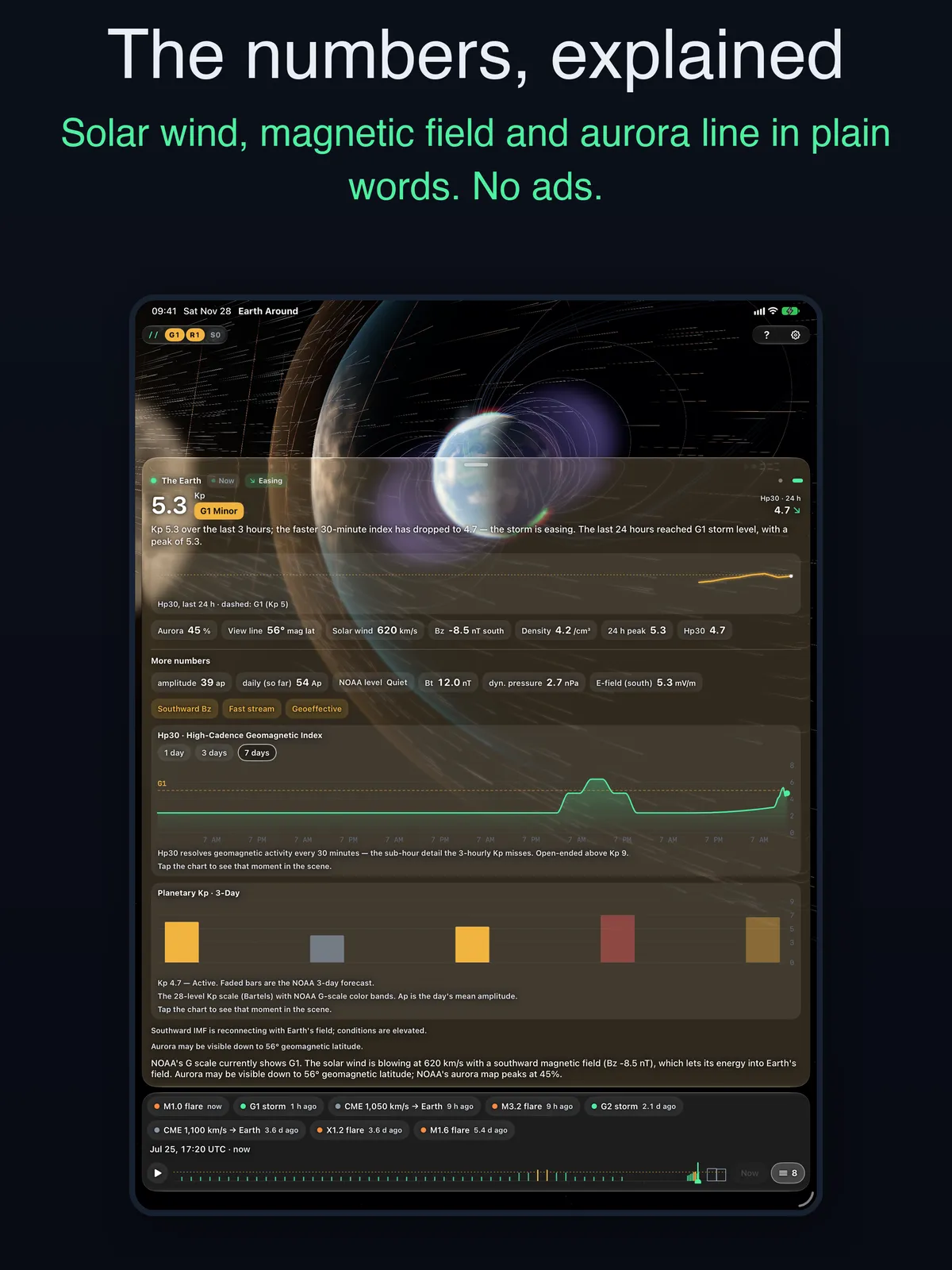
Earth Around shows Bz with its direction ("nT south" or "nT north"), Bt, speed, density, dynamic pressure and the southward electric field from NOAA's real-time solar wind feeds, with three flags: Southward Bz, Fast stream (500 km/s and up) and Geoeffective (southward Bz while the wind is elevated). Its 3D Earth draws the solar wind at the measured speed and density and places the nose of the magnetic shield with the Shue 1998 model, so you can watch the shield move in as the pressure rises; its short guide calls Bz "the door". It needs a connection for live readings and has no account and no tracking.
Frequently asked questions
Is negative Bz good for the aurora?
Yes. Negative Bz means the field points south, which lets it connect with Earth's field and feed energy into the aurora. The more negative and the longer it lasts, the better.
What Bz do you need for a geomagnetic storm?
Typically −10 nT or lower held for about three hours or more, especially with a solar wind above 500 km/s. Around −5 nT for an hour usually gives aurora at high latitudes but not a storm.
Why is the solar wind fast but nothing is happening?
Probably because Bz points north. Speed multiplies the effect of southward Bz; with northward Bz most of the energy stays out.
How far ahead does Bz warn you?
About 30 to 60 minutes. It is measured at L1, about 1.5 million km upstream, and the solar wind takes that long to reach Earth.
Sources
- Dungey, "Interplanetary Magnetic Field and the Auroral Zones", Physical Review Letters, 1961: doi.org/10.1103/PhysRevLett.6.47
- Burton, McPherron and Russell, "An empirical relationship between interplanetary conditions and Dst", Journal of Geophysical Research, 1975: doi.org/10.1029/JA080i031p04204
- Gonzalez and Tsurutani, "Criteria of interplanetary parameters causing intense magnetic storms (Dst < −100 nT)", Planetary and Space Science, 1987: doi.org/10.1016/0032-0633(87)90015-8
- Newell et al., "A nearly universal solar wind–magnetosphere coupling function inferred from 10 magnetospheric state variables", Journal of Geophysical Research, 2007: doi.org/10.1029/2006JA012015
- Shue et al., "Magnetopause location under extreme solar wind conditions", Journal of Geophysical Research, 1998: doi.org/10.1029/98JA01103
- NOAA Space Weather Prediction Center, Real Time Solar Wind: swpc.noaa.gov/products/real-time-solar-wind