
 Overtone Lab
What are LUFS and true peak, and what do the EBU R128 targets mean?
Short answerLUFS is loudness measured to ITU-R BS.1770, which K-weights the signal, averages its energy and gates out silence. EBU R128 sets broadcast programme loudness at −23 LUFS integrated, with true peak no higher than −1 dBTP. True peak is the level between the samples, found by oversampling, and it can sit up to about 3 dB above the highest sample.
A peak meter tells you whether a signal will clip. It says little about how loud the signal sounds: a snare hit and a sustained pad can share a peak level and differ by 10 dB in loudness. Loudness metering measures what listeners hear, so programmes can be matched without anyone reaching for the volume knob.
What does a LUFS reading measure?
LUFS (Loudness Units relative to Full Scale) is the loudness defined by ITU-R Recommendation BS.1770. LKFS, the name used in North American documents, is the same unit. One LU is one decibel of loudness.
The measurement has four steps:
- K-weighting. Each channel passes through two filters: a high shelf of about +4 dB above roughly 1.5 kHz, which models the acoustic effect of the head, and a high-pass near 38 Hz (the "RLB" curve), which discounts deep bass.
- Mean square. The filtered signal is squared and averaged over a block.
- Channel weighting. The channels are summed with weights: 1.0 for left, right and centre, about 1.41 (+1.5 dB) for the surround channels. The LFE channel is left out.
- Logarithm. Loudness = −0.691 + 10 × log₁₀(weighted sum). The −0.691 offset cancels the K-filter's gain at 1 kHz, so a 1 kHz tone reads the same on the loudness scale as its RMS level would suggest.
A worked check: a 1 kHz sine at −23 dBFS on both channels of a stereo file measures −23.0 LUFS. This is the first test signal in EBU Tech 3341, the conformance document for meters. The same sine on one channel only measures 3 dB lower, −26.0 LUFS, because half the energy is missing.
Why do momentary, short-term and integrated readings differ?
The same calculation runs over three time windows (EBU Tech 3341):
| Reading | Window | Used for |
|---|---|---|
| Momentary (M) | 400 ms, sliding | Following phrases and transients |
| Short-term (S) | 3 s, sliding | Mixing by ear; level over a bar or two |
| Integrated (I) | Whole programme, gated | The figure a delivery spec states |
Integrated loudness is gated, which keeps silence and quiet passages from dragging the average down. Audio is cut into 400 ms blocks overlapping by 75%. Blocks below −70 LUFS are discarded (the absolute gate). The average of the rest is computed, and blocks more than 10 LU below that average are discarded too (the relative gate). The average of what remains is the integrated loudness.
A separate measure, loudness range (LRA, EBU Tech 3342), describes how much the short-term loudness varies across a programme. It is a statistic of the short-term readings, not another window.
What is true peak, and why is it higher than sample peak?
A digital signal is a set of samples. The analogue waveform a converter rebuilds passes smoothly through them and can rise above every one of them between samples. A sample-peak meter cannot see that overshoot. The worst simple case is a sine at a quarter of the sample rate, sampled at 45° into its cycle. Every sample lands at 0.707 of the real peak, so the meter reads 3 dB low.
BS.1770 Annex 2 measures true peak instead: oversample the signal by four times at 48 kHz (more at lower rates) with an interpolation filter, then take the highest absolute value. The result is quoted in dBTP. Inter-sample peaks matter because a lossy encoder or a cheap converter can clip on them even when no sample reaches 0 dBFS.
What do the EBU R128 targets mean?
EBU Recommendation R 128 sets the broadcast target for European television and radio:
- Programme loudness: −23.0 LUFS integrated. A tolerance of ±0.5 LU applies to most programmes, and ±1 LU where an exact target is impractical, such as live shows.
- Maximum true peak: −1 dBTP. The EBU production guidelines (Tech 3343) advise a lower ceiling for programmes that will go through lossy coding.
Other specifications apply the same measurement with different numbers. ATSC A/85, used in North America, targets −24 LKFS with true peak no higher than −2 dBTP. Many streaming services normalize playback to an integrated loudness, typically between −14 and −16 LUFS. Each service publishes its own figure, and the figures change, so check the current specification before a delivery.
None of these targets says how loud a master should be. They say how loud it will be played back. A master louder than the target is simply turned down, and it keeps whatever dynamic range it lost on the way up.
Where does Overtone Lab fit?
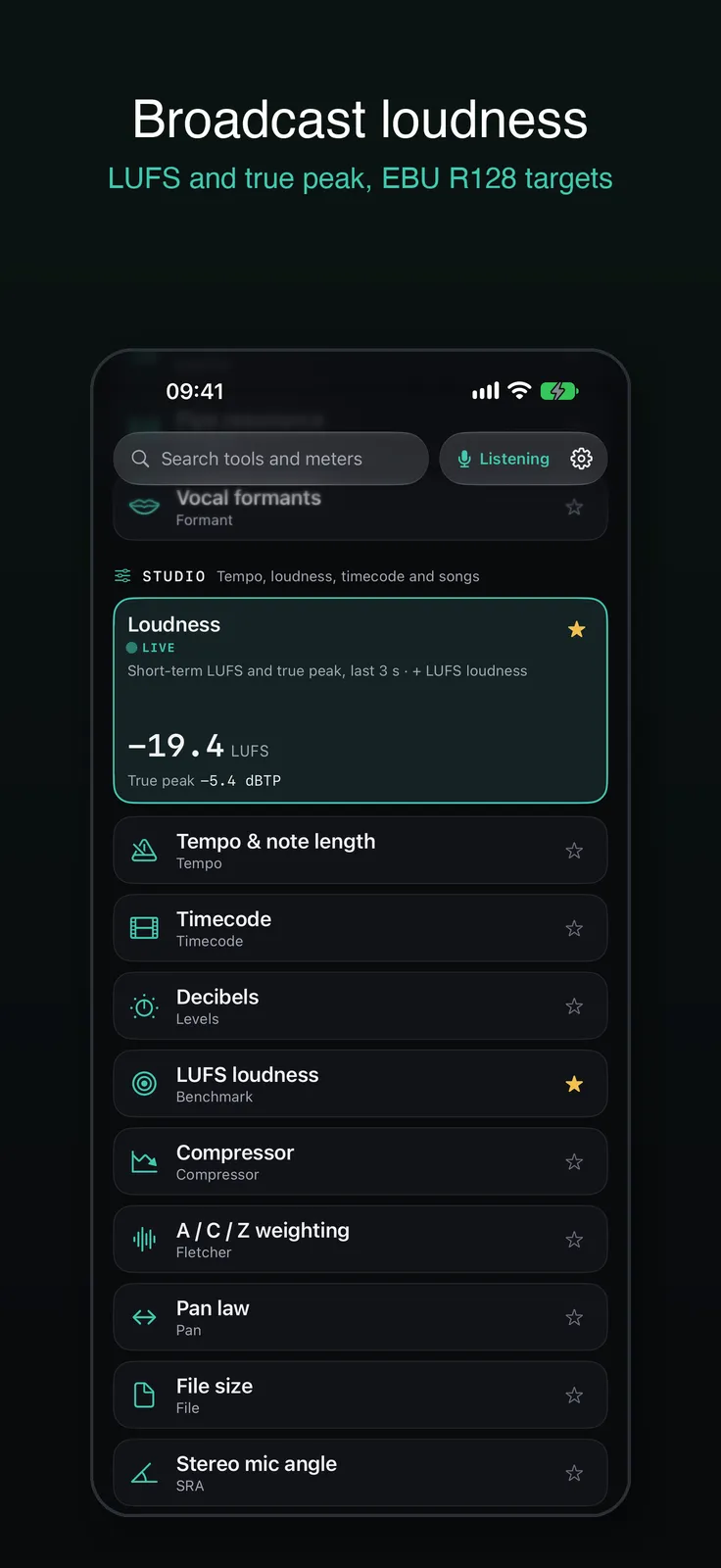
Overtone Lab has a live loudness tile on its Bench. It reads EBU R128 short-term loudness, a 3 s window K-weighted to BS.1770, and true peak by 4× oversampling as BS.1770 Annex 2 specifies, from the microphone or input you choose. It shows nothing until it has a full 3 s of signal, because Tech 3341 defines no short-term value for a partial window. Its LUFS loudness calculator (Benchmark) computes the BS.1770 integrated loudness of a test tone and sets it against common targets, EBU R128's −23 LUFS among them.
The app does not measure loudness range or a long-term integrated reading of a live programme. For a delivery that must meet a specification, measure the final file in a conformant meter.
Frequently asked questions
Are LUFS and LKFS the same?
Yes. Both name the loudness of ITU-R BS.1770; LKFS is the term in ITU and ATSC documents, LUFS in EBU documents. One LU equals one dB.
Why does my master measure louder in LUFS than its RMS level?
K-weighting raises everything above about 1.5 kHz by up to 4 dB, so a bright mix measures louder than its unweighted RMS. Deep bass below about 60 Hz counts for less.
Is −1 dBTP enough headroom for lossy encoding?
Often not. Encoders can add overshoot of their own, which is why EBU Tech 3343 and many distributors ask for a lower true-peak ceiling for coded delivery.
Sources
- ITU-R Recommendation BS.1770, Algorithms to measure audio programme loudness and true-peak audio level: itu.int
- EBU R 128, Loudness normalisation and permitted maximum level of audio signals, and EBU Tech 3341, Loudness Metering: "EBU Mode" metering to supplement EBU R 128 loudness normalisation: tech.ebu.ch
- EBU Tech 3342, Loudness Range: A measure to supplement EBU R 128 loudness normalisation, and EBU Tech 3343, Guidelines for Production of Programmes in accordance with EBU R 128.
- ATSC A/85, Techniques for Establishing and Maintaining Audio Loudness for Digital Television.